
Union County Arrest Records and Court Charges
Union County arrest records start with the arresting agency and the jail or booking process. The Union County Sheriff's Office is the local office tied to jail custody, inmate responsibility, warrant service, civil process, delinquent state tax collection, and foreclosure sale duties. The sheriff page names Sheriff Jeff Adams and gives the sheriff's office as the direct local source for jail or arrest-side questions. That does not make every booking note a court charge. A booking entry may describe the suspected offense at intake, while the court charge is the formal count filed by the State.
Charges after arrest move through a different path. Indiana uses the term Prosecuting Attorney, not district attorney. The Union County Prosecutor represents the State of Indiana in prosecuting alleged violations of state law. Once the prosecutor files a charge in Union County Circuit Court, the Clerk maintains the court record. The formal case may show the offense title, Indiana Code citation, level, count number, filing date, plea, disposition, sentence, and amended or dismissed status. For jail roster detail, use Union County inmate records. For the whole criminal case from filing through sentence, use Union County criminal court records.
The local offices are also physically split. Court, clerk, and prosecutor records route to the Union County Courthouse, while sheriff and jail questions route to the sheriff's office on East Union Street. That split matters when checking a Union County arrest record because one incident can create a sheriff booking record, a prosecutor filing decision, and a court case record.
Search Union County Arrest Records and Charges
Filed charges are searched through the Indiana Public Access Portal, also known as MyCase. The Indiana Judicial Branch Union County page routes case search traffic to MyCase, and the Union County Circuit Court page says court records are available through the Indiana State Court Administration website. MyCase is best for the court side: charge counts, hearing dates, case status, chronological case summary entries, financials, and many public orders. It is not the official court record, and it may not include every document.
- Open MyCase or the Indiana Public Access Portal.
- Search by case number when available. If not, search by defendant name and narrow the county to Union County.
- Open the matching criminal or infraction case and read the charge list, case status, hearing history, and financial entries.
- Compare each count with later docket entries because a charge may be amended, reduced, dismissed, or resolved by plea.
- Contact the Union County Clerk for certified copies, older documents, or public documents not linked online.
For the arrest side, the sheriff remains the local fallback. The sheriff page does not publish a Union County booking-search database. The statewide county jail fallback is the Indiana County Jail Public Portal, which can show county custody information where supplied. Because jail data can lag and court data can change after the prosecutor reviews the case, a careful search checks both the jail source and MyCase before drawing a conclusion.
The Union County Prosecutor page is the source for the local prosecuting office.
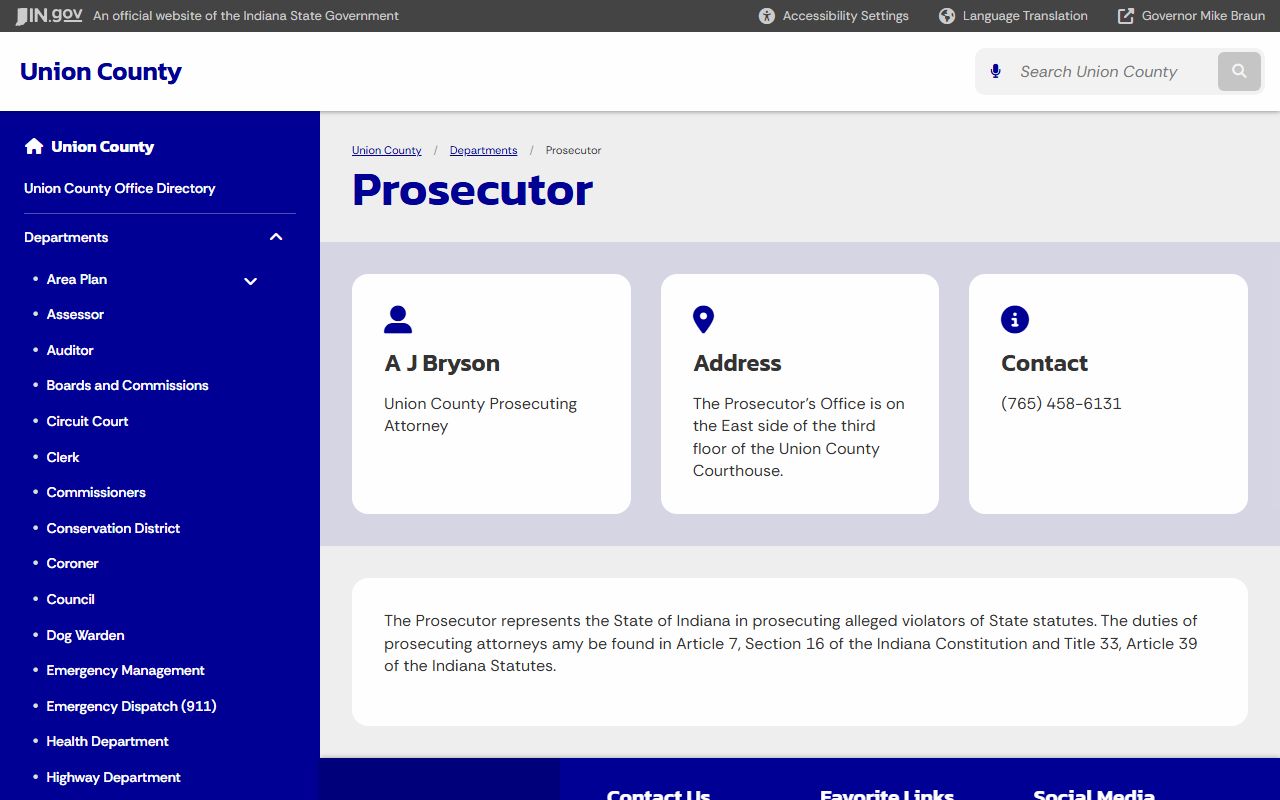
That office is important because the prosecutor, not the sheriff, controls the formal charge that appears in the Union County court record.
Union County Charging Documents
A charge record begins with a filing that tells the court what the State alleges. Research for Union County did not locate a local sample charging form, so the useful distinction is the role of the document rather than a local form image. A complaint, information, or indictment can start or frame the criminal count. The record may then be updated by amended filings, plea agreements, court orders, or dismissal entries. The filed document is different from an arrest narrative or jail intake line.
| Document | Who Uses It | What It Does | Union County Lookup Point |
|---|---|---|---|
| Complaint | Law enforcement or prosecutor | States the factual and legal basis for an alleged offense. | Search the criminal case in MyCase and ask the Clerk for official copies. |
| Information | Prosecuting Attorney | Sets out one or more formal counts filed by the State. | Look for charge counts, Indiana Code citations, and filing entries. |
| Indictment | Grand jury process | Accuses a person after grand jury action in matters where that route is used. | Verify public availability through the Clerk because access may depend on the case posture. |
Each count can stand on its own. One arrest may lead to no filed charge, one filed count, or several filed counts. The charge line should be read with the case status and disposition because the original filed level may not be the same as the final outcome.
Union County Charge Status Terms
Charge status is the point where many Union County arrest records searches become confusing. A court record may show a charge that was filed, then changed by a later entry. The early count is still part of the case history, but it may not describe the final result. MyCase can show public charge information, hearings, financials, and final orders or judgments, while the official file remains with the Clerk.
| Status | Plain Meaning | What to Check Next |
|---|---|---|
| Pending | The charge has not reached final disposition. | Review hearing dates, bond entries, and any pending motions. |
| Amended | The prosecutor or court record changed the charge description, citation, count, or level. | Compare the original count with the latest charging entry. |
| Reduced | The charge was lowered to a lesser offense or level. | Read the plea or disposition entry before treating it as a conviction. |
| Dismissed | The charge was ended by court order or prosecutor action. | Check whether the dismissal was with or without prejudice. |
| Disposed | The charge reached an outcome, such as plea, verdict, dismissal, or other final action. | Read the specific disposition, not just the word disposed. |
The Indiana Code Title 35 source is relevant to criminal procedure, charging, sentencing, and expungement topics.
Indiana Code citations on a Union County charge record should be read as statute references, while the docket tells how that count moved through court.
Union County Charges vs Convictions
A charge is an accusation. A conviction is a legal outcome. Union County court charge records may be public even when a case has not ended, so the difference matters for employment screens, housing decisions, licensing questions, and personal checks. Public court access does not turn an allegation into proof. A person can be arrested and never charged, charged and later dismissed, or convicted only of a reduced count.
| Point of Comparison | Charge | Conviction |
|---|---|---|
| Meaning | Formal allegation filed in court. | Judgment that the defendant is guilty by plea or verdict. |
| Timing | Appears near the start of the criminal case. | Appears after plea, trial, or other final court action. |
| Record Fields | Count, offense, statute, level, filing date, and status. | Disposition, sentence, fines, probation, and final judgment entries. |
| Risk of Misread | May be amended, reduced, or dismissed. | May still need sentence and expungement context. |
For formal use, verify the result through the Union County Clerk. MyCase terms state that public access is free but is not the official court record. The Clerk can address certified copies, missing online documents, and current case balances.
Restricted Union County Charge Records
Indiana court access starts with public access and then applies exclusions. Access to Court Records Rule 4 states the general public-access rule. Rule 5 excludes certain cases, documents, identifiers, mental-health records, treatment records, juvenile material, protected victim or witness information, and some warrant-related material. For Union County arrest records and court charges, that means a search result can be incomplete for lawful reasons.
Juvenile records are a major limit. Indiana juvenile law and Rule 5 restrict many juvenile court and law-enforcement records. Protection order data also has special online limits because protected-person names and identifying details are excluded from online public access. Mental health cases under IC 12-26 are excluded in their entirety. Complete Social Security numbers, account numbers, PINs, passwords, and certain victim or witness contact details are not ordinary public fields.
- Sealed record
- Removed from ordinary public view by statute, rule, or court order. Ask the Clerk what can be confirmed publicly.
- Expunged record
- Eligible arrest, charge, or conviction records may be sealed or limited under IC 35-38-9. Check the current statute before assuming eligibility.
- Juvenile matter
- Often confidential or limited. Do not expect standard MyCase access.
- Active warrant request
- Some records may be temporarily excluded if public disclosure creates flight, safety, or investigation risks.
The Indiana Rule 5 page documents exclusions that affect public charge records.
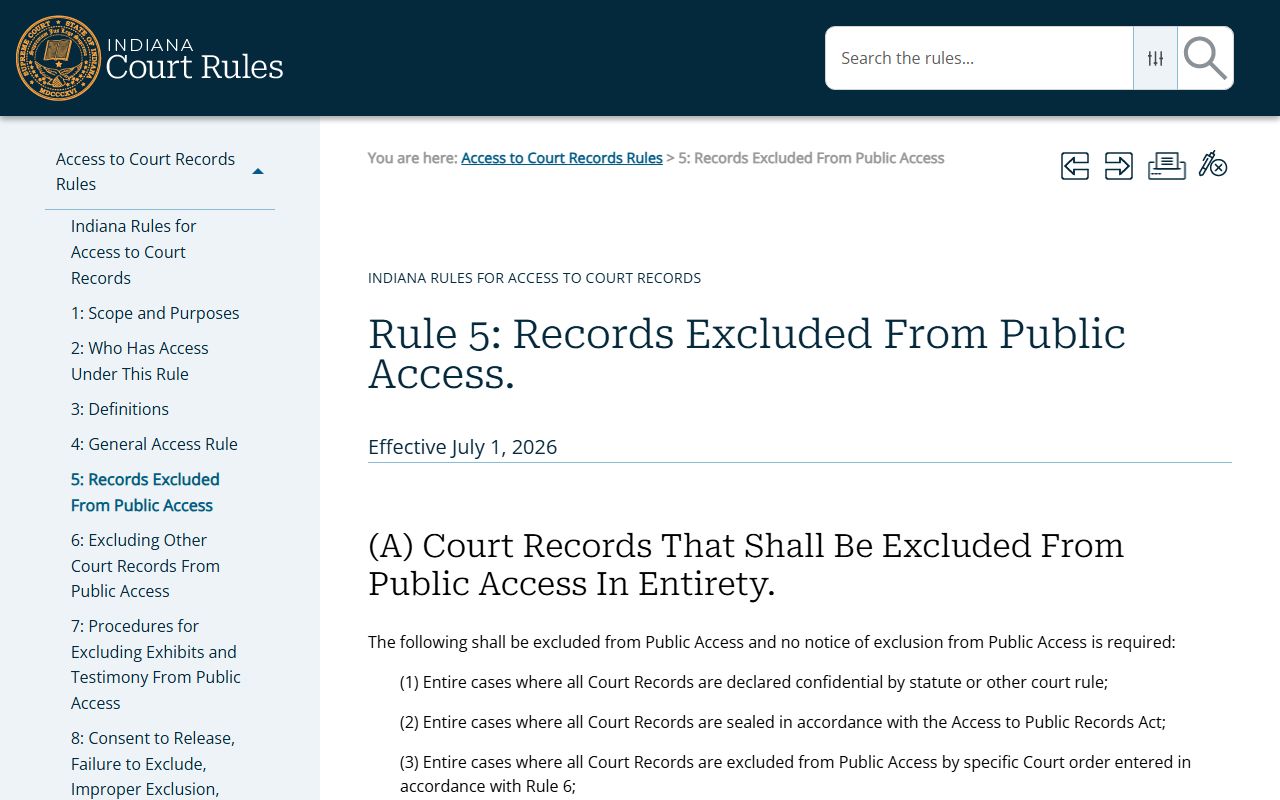
Those exclusions explain why a Union County charge, warrant entry, or arrest-related event may not appear in an ordinary public search.
Union County Records Request Fallback
When the charge or arrest-related record is not online, Union County's local public-records guidance becomes the fallback. The county instructs requesters to direct requests to the elected official or department head responsible for the record, make the request specific and clear, and be ready to pay reproduction costs. The Clerk is the route for official court documents. The Sheriff is the route for sheriff arrest, booking, jail, warrant-service, and civil-process records. The Prosecutor handles prosecutor records, but the office does not give legal advice to defendants or victims outside its role.
A strong request gives the person's full name, date range, case number if known, record type, office addressed, preferred delivery method, and contact information. A broad demand for all records may be rejected or may lead to an invitation to inspect records in person. Indiana's Access to Public Records Act is the state public-records framework, but court access is also governed by the Indiana court rules.
Important: Public charge records should not be used for FCRA-regulated screening without a compliant consumer-reporting process.